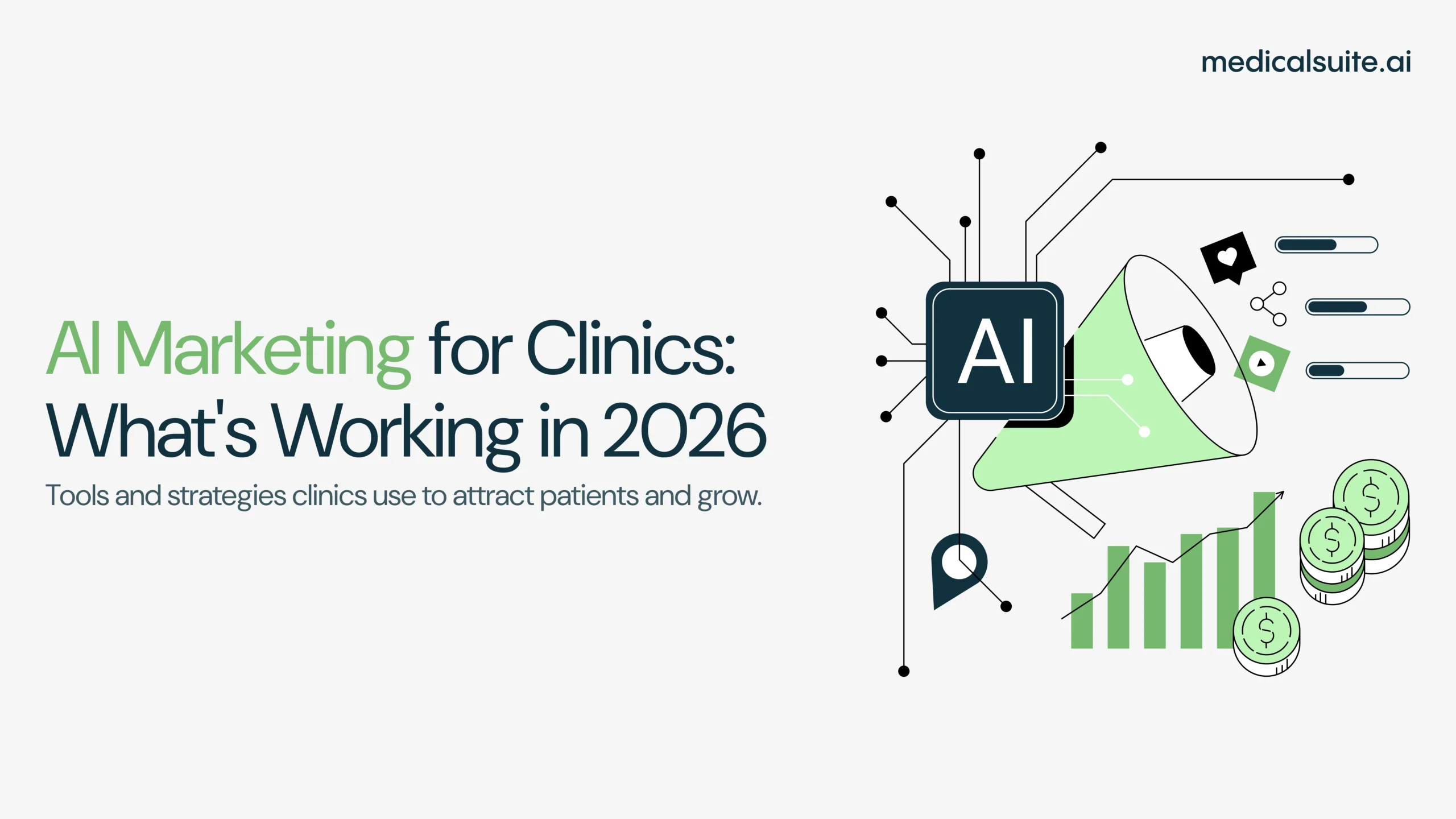
AI marketing has quietly become one of the most powerful growth levers for healthcare clinics in the US right now, and most clinic owners either don’t know that yet, or they’ve heard the term so often it’s become noise. It’s not noise. Clinics that are actively using AI-driven marketing tools are filling their appointment books faster, spending less on ads that don’t convert, and building a patient pipeline that doesn’t depend on word-of-mouth alone. That shift is real, and it’s happening right now across every specialty from primary care to orthopedics to behavioral health.
At MedicalSuite, we work exclusively with healthcare clinics across the US, and we’ve seen firsthand what separates the practices that grow consistently from the ones that stay stuck. It almost always comes down to how they’re using or not using the right digital tools. We put together this guide to walk you through the AI marketing tools that are actually moving the needle for clinics in 2026, what they do, and how to build them into your practice without it feeling like a second job.
1. AI-Powered SEO Tools: Because “Build It, and They’ll Come” is a Myth
If your clinic’s website is sitting on page 3 of Google, it might as well be invisible. No one, and we mean no one, is clicking to page 3 to find a gastroenterologist.
AI marketing has completely transformed SEO from a dark art into something more manageable. Tools like Surfer SEO, Clearscope, and Semrush’s AI features can now analyze what your top competitors are ranking for, identify content gaps, and actually tell you what to write and how to structure it to rank.
For healthcare clinics, this is especially powerful for local SEO. When someone in Dallas searches “gastroenterologist near me” or “urgent care open Sunday in Austin,” AI-driven local SEO strategies are what put your clinic at the top of that list, not luck.
What to actually do: Make sure your Google Business Profile is fully optimized with services, hours, photos, Q&A, and use an AI-assisted SEO tool to identify the top 10–15 search terms your potential patients are using in your specific city or region. Then build content around those terms.
Tools worth looking at: Semrush, Ahrefs, Surfer SEO, and BrightLocal for local listings management. These are the AI marketing tools that serious clinics are already using, and if you’re not, you’re probably losing patients to the ones that are.
2. AI Chatbots and Automated Patient Communication
Picture this: it’s 11:30 PM on a Tuesday. A potential patient lands on your website, has a question about whether their insurance is accepted, and wants to request an appointment. Your office is closed. Your receptionist is asleep. This is exactly the gap AI marketing fills, and without it, that patient leaves and probably books with whoever answers them first in the morning, which might not be you.
AI marketing tools like Drift, Tidio, or healthcare-specific platforms like Luma Health and Klara let you deploy intelligent chatbots that answer FAQs, collect patient info, confirm appointments, and even triage urgency 24/7, without a human needing to be involved.
One thing worth flagging: any chatbot or communication tool you use must be HIPAA-compliant. Not “probably fine”, compliant actually verified compliant. This isn’t just a legal technicality; it’s about protecting your patients and your practice.
Real impact: Clinics using AI-powered chat and appointment automation consistently report a 20–35% reduction in no-shows and a significant uptick in appointment requests from after-hours website traffic. That’s real revenue, not theoretical.
3. AI-Driven PPC and Paid Advertising
“We tried Google Ads, spent $4,000, got nothing, never again.” We’ve heard some version of this from almost every clinic owner we’ve ever worked with. And honestly? The problem usually isn’t the platform; it’s the strategy, the targeting, and the lack of ongoing optimization. This is precisely where AI marketing has made PPC dramatically more effective and way less wasteful.
Google’s Performance Max campaigns and Meta’s Advantage+ ad tools now use machine learning to automatically optimize who sees your ads, when, and at what bid. They learn from your campaign data in real time. They adjust. They improve. When set up correctly, they genuinely outperform manually managed campaigns over time.
For healthcare clinics, the magic is in hyper-local targeting. You’re not trying to reach everyone in America; you’re trying to reach someone in a 10-mile radius who needs a cardiologist and is actively searching right now. That’s what AI marketing does best: precision targeting that wasn’t possible even three years ago.
Don’t forget: Healthcare advertising on Google and Meta has specific restrictions around sensitive health conditions. Make sure your ad copy and landing pages comply with their policies, and yes, there are AI tools that help you check this automatically.
4. AI Content Creation and Blog Automation
“My clinic doesn’t have time to write blog posts. We have patients to see.” Fair. Completely fair. But educational content is one of the highest-ROI investments a healthcare clinic can make for long-term SEO and patient trust, and you don’t have to write it yourself anymore.
AI marketing tools like Jasper and Copy.ai can generate first drafts of patient education content, FAQ pages, condition explainers, and local health guides in minutes. The caveat, and it’s an important one, is that AI content in healthcare always needs human review before it goes live. Accuracy in medical content matters in a way it doesn’t in a recipe blog. Have a physician or qualified staff member look it over. That’s not extra work; that’s protecting your patients and your practice’s reputation.
When you pair AI content creation with your SEO strategy, you build out a library of relevant, search-optimised content that keeps bringing new patients to your website for years. That’s compounding digital marketing.
5. AI-Powered Review Management and Reputation Tools
Reviews are, without exaggeration, one of the most important factors in a patient’s decision to choose your clinic. And managing them manually, responding to every Google review, monitoring Healthgrades, and tracking Yelp is practically a part-time job.
AI reputation management tools like Podium, Birdeye, and RepuGen are designed specifically for healthcare. They send automated review request texts after appointments, flag negative reviews instantly so you can respond fast, and generate AI-assisted response drafts for you to review and send. It’s AI marketing working quietly in the background, protecting and building your reputation without you having to think about it.
Here’s a truth worth sitting with: a clinic with 200 Google reviews averaging 4.7 stars will almost always beat a clinic with 15 reviews averaging 5.0 stars in terms of new patient acquisition. Volume matters. Recency matters. AI marketing tools make it infinitely easier to build and maintain that review presence consistently.
Quick win: If your clinic isn’t currently asking patients for reviews in a systematic, automated way, that’s probably the single highest-ROI thing you can start doing this week. Set up an automated post-visit text or email sequence. You’ll be surprised how quickly the reviews accumulate.
6. Data Automation and AI Analytics
This one is a bit more behind the scenes, but it might be the most powerful thing on this list for clinic operators who want real visibility into what’s working.
AI marketing analytics tools, such as Google Analytics 4’s AI insights, HubSpot’s AI features, or platforms like PatientPop, can analyze your patient acquisition data, identify where patients are dropping off in your booking funnel, predict seasonal demand patterns, and flag which marketing channels are actually driving new patient visits. Without this, you’re essentially flying blind. You might be spending 60% of your marketing budget on something that drives 10% of your results.
Data automation also extends to appointment reminders, waitlist management, and patient follow-up sequences, all of which feed directly into your growth engine.
7. Your Website Might Be Quietly Killing Your Growth
We’ve looked at hundreds of healthcare clinic websites. And honestly, most of them are not doing the clinic any favors. Slow load times, hard-to-find contact info, no clear calls to action, not mobile-optimized, and not accessible for patients with disabilities. Your website is your digital front desk. If a patient walks up to your front desk and no one greets them, the door is hard to find, and the sign-in form is confusing, they leave. The same thing happens online.
AI marketing is now deeply integrated into web design and optimization. AI tools can do heatmap analysis to show you exactly where users are clicking and where they’re giving up, A/B test different versions of your homepage automatically, and optimize page speed in real time.
And we have to say this clearly: ADA and HIPAA compliance on your website isn’t optional. ADA compliance ensures your website is accessible to patients with disabilities, which is also a legal requirement under the Americans with Disabilities Act. HIPAA compliance means any patient data collected through your site is handled securely and lawfully. Getting these wrong isn’t just a PR problem; it can be a serious legal and financial one. We’ve seen clinics get hit with ADA lawsuits over inaccessible websites. It’s a real risk, and it’s completely avoidable.
We’ve Done This Before. For Clinics Just Like Yours.
We’ve worked with clinics like GI Partners of Illinois, Greenleaf Medical Associates, DHS, and GAINS, real practices with real growth challenges, and helped them build marketing systems that work every day, even when their team is heads-down with patients.
Here’s what we bring to the table:
Digital Marketing: Full-funnel strategy built specifically for healthcare, from attracting new patients to keeping existing ones engaged.
Custom Websites: Not templates. Not cookie-cutter. Websites built around how your patients think, what they search for, and what makes them book.
ADA & HIPAA Compliance: We make sure your digital presence isn’t just effective, it’s legally sound. Because the last thing you need is a compliance headache on top of everything else.
SEO: Local, technical, and content-driven strategies that put your clinic in front of patients who are actively searching for you.
PPC Ads: AI-optimized paid advertising that doesn’t drain your budget; it grows with your results.
Data Automation: Smart systems that connect your marketing, your patient journey, and your operational data so nothing falls through the cracks.
The Clinics Growing Fastest in 2026 All Have One Thing in Common
They stopped waiting for the “right time” to invest in their marketing. They stopped assuming good clinical care alone would fill their appointment books. And they stopped treating their digital presence like an afterthought.
AI marketing isn’t some futuristic thing that’s coming eventually. It’s here. It’s working. And the clinics using it are pulling ahead while the ones ignoring it wonder why their waiting rooms aren’t as full as they used to be.
You don’t have to figure this out alone. That’s literally what we’re here for.
Patients Are Choosing. Make Sure They’re Choosing You.
Every day, patients in your area are searching, comparing, and booking, and the clinic that shows up first, looks credible, and makes it easy to win that appointment. The question isn’t whether your patients are out there. It’s whether they can find you.
Book your consultation at medicalsuite.ai now, and let’s make sure they do.