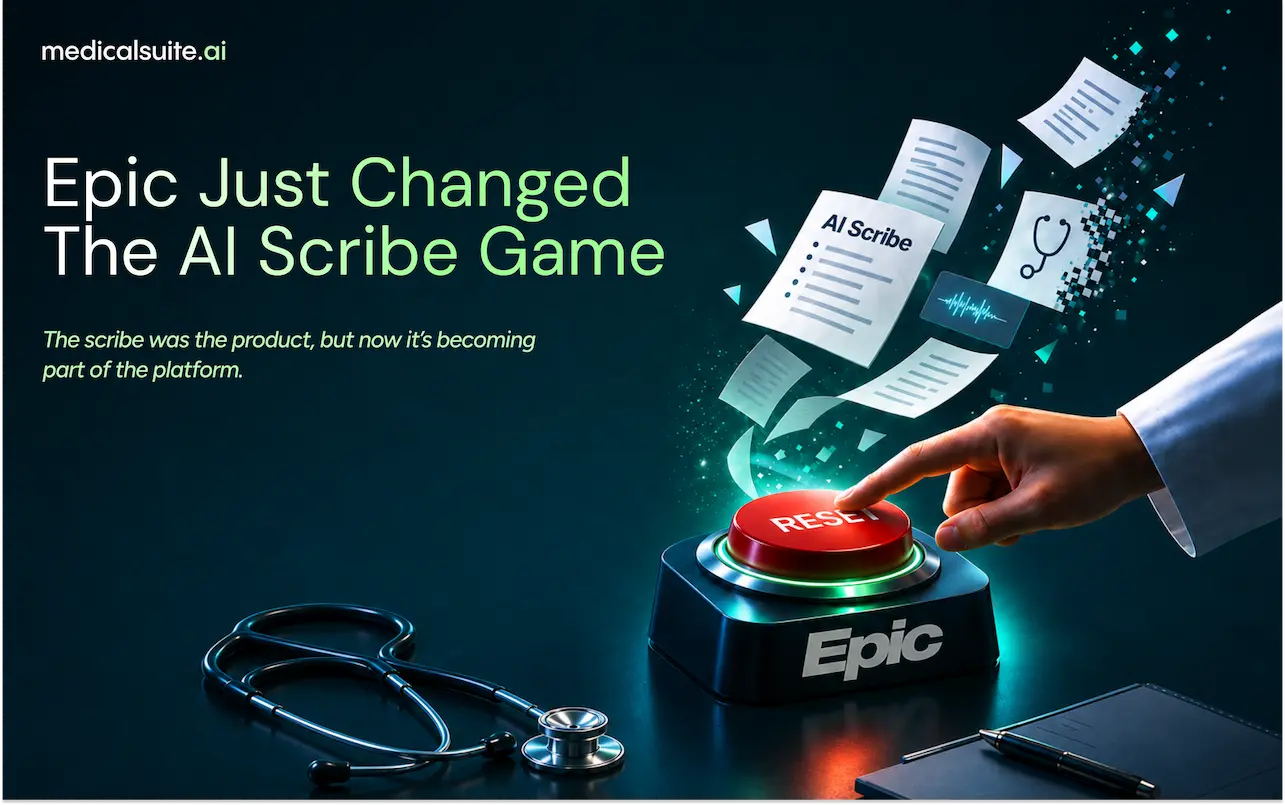
In February 2026, Epic rolled out its AI scribe, Art for Clinicians, to its entire customer base at no extra cost. This didn’t kill the AI scribe market. It pushed startups like Heidi Health and Suki to move past note-taking into decision support, coding, and patient communication. For doctors, plain transcription is now table stakes. The tools worth evaluating are the ones that act on the note, not just write it.
When the largest player in a market gives away your core product for free, you have two options. Fade into irrelevance, or build something that can’t be given away. The AI scribe startups that survived Epic’s move chose the second option, and their strategy tells you exactly what to look for in your own documentation tools.
The Move That Reshaped the AI Scribe Market
Healthtech startups raised $1.6 billion to build AI scribes in 2025, according to PitchBook. The problem they were solving was real: clinicians buried in documentation, burning out under administrative load. The pitch was simple. Let AI listen to the visit and draft the note.
Then Epic changed the rules.
Epic unveiled Art for Clinicians in August 2025. By February 2026, the note-drafting feature was live across its entire customer base, with no separate procurement needed. That’s an EHR used by 42% of US acute-care hospitals, covering 55% of hospital beds nationwide.
The adoption numbers moved fast. Fierce Healthcare reported that 85% of Epic’s healthcare customers are now live with generative AI tools, and Art’s patient-summary feature is used 16 million times a month, nearly triple its usage from three months prior.
In tech circles, this pattern has a name: getting Sherlocked, after Apple’s habit of building third-party app features directly into iOS. Epic just did the healthtech version of it to AI medical scribes.
Why Epic Gave Art Away for Free
Epic’s decision isn’t generosity. It’s strategy, and it serves three goals at once.
- It deepens the ecosystem moat. Every native feature is one less reason to shop outside Epic. A scribe that’s already in the workflow and already tied to the patient record raises the bar for what would justify switching to a third-party tool.
- It accelerates adoption at a scale no startup can match. Free, pre-integrated access removes the two biggest adoption barriers: budget approval and integration work. That’s how a feature hits 16 million monthly uses in months, not years.
- It stakes Epic’s claim as the clinical AI platform, not just the record-keeper. Every drafted note and generated summary deepens that platform relationship.
For doctors, the short-term news is good. A scribe that’s already integrated and already familiar cuts documentation time with zero setup. But it raises a real question: if note-taking is now a standard feature, what happens next?
Why AI Scribe Startups Are Still Growing
The obvious prediction after Epic’s announcement was that scribe startups were finished. Why pay for something Epic hands you for free?
That’s not what happened. The startups still growing all share one trait: none of them are just taking notes anymore.
- Heidi Health now handles 2 million consultations a week across more than five countries. It has expanded into clinical decision support and patient communication tools, with growth into the UK, South Africa, and Southeast Asia.
- Suki has pushed into prescription workflows and medical coding, generating prescriptions and suggesting billing codes instead of stopping at the note.
Different products, same instinct. Note-taking was always the entry point, not the destination. The value is in what happens after the note exists.
What This Means for Doctors: 4 Questions to Ask
1. Does this tool do anything beyond note-taking?
If the honest answer is “just notes,” you’re likely behind the leading edge. Look for decision support, coding assistance, care gap identification, and patient communication built on top of the transcript.
2. How deep is the integration?
A note that must be manually copied into your EHR creates friction every time it’s used. A tool embedded in your workflow fades into the background and actually gets used.
3. What’s on the vendor’s roadmap?
If the answer is “better note-taking,” that’s worth a harder look at alternatives. The market has already decided that transcription is infrastructure, not a differentiator.
4. Does it replace judgment, or support it?
These tools operate in the realm of suggestion. Weighing evidence, reading patient context, and making the final call stays irreducibly human. What’s changing is how much support you get before that moment and how much administrative weight lifts after it.
The Bottom Line
You’re managing a full patient panel with no spare hour to evaluate AI vendors, and that’s exactly the gap Medicalsuite.ai fills. We track Epic’s platform moves, the next generation of scribe startups, and the decision-support tools reshaping clinical practice, so you get a recommendation that fits your workflow instead of a pile of research homework.
Book a free consultation and find out what’s actually worth adding to your stack.
What is Epic’s Art for Clinicians?
Art for Clinicians is Epic’s built-in AI scribe. It drafts clinical notes and patient summaries directly inside the EHR and became available to Epic’s full customer base in February 2026 at no additional cost.
Did Epic’s free AI scribe replace third-party scribe startups?
No. Startups like Heidi Health and Suki are still growing, but they’ve shifted from pure transcription into decision support, medical coding, and patient communication, areas Epic’s native tool doesn’t cover.
Is AI scribing still worth paying for if Epic includes it for free?
It depends on what the paid tool does beyond transcription. If it only drafts notes, Epic’s free version likely covers that need. If it adds coding automation, care gap alerts, or decision support, it may still justify the cost.
What should doctors look for in an AI documentation tool in 2026?
Depth of EHR integration, capabilities beyond note drafting (coding, decision support, patient communication), and a product roadmap focused on clinical action rather than just faster transcription.