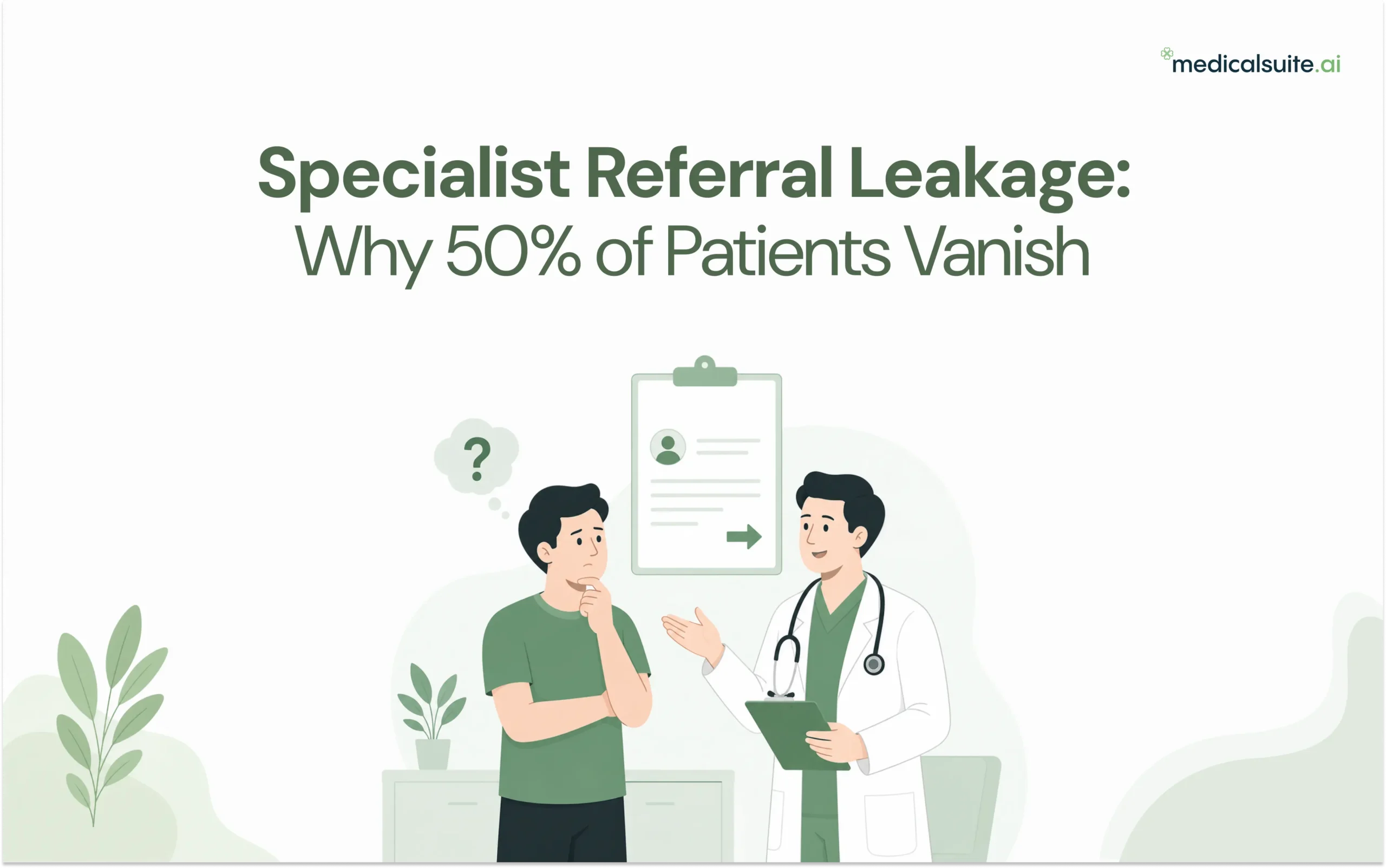
A specialist referral is supposed to be a bridge to better care. Too often, it’s the moment your patient vanishes.
No breach. No headline. Just a quiet, chronic leak that drains millions from health systems and erodes outcomes year after year.
The Number Nobody Puts on the Board Slide

Industry data consistently shows that 50% to 65% of specialist referrals never result in a completed appointment.
That isn’t anecdotal. A landmark study in the Journal of General Internal Medicine found only 54% of referrals ended in a completed specialist visit. A later systematic review in BMJ Open pooled multiple studies and found a completion rate of just 51%, with individual studies ranging from 38% to 69%.
Sit with that. For every ten patients you refer, three to five actually get the care you intended. The rest disappear into scheduling dead ends, unanswered calls, insurance roadblocks, and slow disengagement.
Follow One Referral, and You’ll See Where It Dies
The idealized workflow diagram is not what patients experience. Here is the real journey.
- The fax is in the stack. A PCP orders a cardiology consult. It becomes a sheet of paper competing with dozens of others for a scheduler’s attention. Days become weeks. The patient hears nothing, assumes the system is working, and eventually stops waiting.
- The phone tag: nobody wins. Outbound calls hit people during business hours. Patients miss them, call back, reach voicemail. After two or three failed attempts, a significant portion disengages entirely. The burden of persistence lands on the sick person, which is exactly backward.
- The insurance maze. The specialist is in-network on paper, but a prior authorization was never initiated, or the directory wasn’t updated when they dropped the plan. The patient hears an unexpected number at the front desk and walks away.
- The “I’ll figure it out later” effect. The patient fully intends to schedule. Symptoms feel manageable. Urgency fades. Months later, that manageable condition re-enters through the emergency department at a cost that dwarfs the consult.
In every case, the specialist referral was technically “made.” But making a referral is not the same as completing a care transition. That gap is where patients and revenue disappear.
What One Dead Referral Actually Costs You
Direct revenue. Every incomplete specialist referral is a lost specialist visit, lost follow-ups with the referring provider, and lost ancillary revenue from labs, imaging, and procedures that would have cascaded from the consult. Annual leakage routinely represents measurable financial loss, revenue already earned in the initial encounter and then simply forfeited. Compounded over years, it moves operating margins.
Downstream clinical cost. Unmanaged hypertension doesn’t hold steady. It deteriorates into a stroke or cardiac event with hospitalization, ICU time, and rehab attached. The cost differential between a routine specialist visit and an acute inpatient stay is predictable, not hypothetical.
Quality metric erosion. Value-based contracts tie reimbursement to measures that depend on completed referrals. Every specialist referral that stalls is a missed mammogram, an unchecked A1C, a colonoscopy never scheduled.
Patient trust. Your provider said, “I’m sending you to someone who can help.” Then nothing happened. Patients don’t blame the specialist’s office. They associate the failure with the person who started the process.
Hiring More Coordinators Won’t Fix This
The instinct is to try harder. Add a care coordinator. Track outstanding referrals on a spreadsheet. Make more calls.
That misdiagnoses the problem. Traditional referral management treats each specialist referral as a transaction. It asks, “Was the referral sent?” Fax confirmed, note entered, box checked, baton passed. What happens next is someone else’s problem.
This is the hand-off fallacy. Healthcare isn’t a relay race. The referring provider remains the patient’s guide and the system’s steward for the whole journey.
Your tools reinforce the wrong mindset. Fax machines track nothing after transmission. EHR referral modules show “referred” with no downstream visibility. Spreadsheets are only as current as the last manual update, and by then the patient has been lost for weeks. You cannot solve a continuous-journey problem with discrete-transaction tools.
Pillar One: Track Referrals Like a Package
Every specialist referral should generate a continuous digital thread from decision through clinical close-out.
Sent gets recorded. Acknowledged gets captured. Scheduled populates automatically. Cancelled or no-showed surfaces immediately. Sitting in “sent but not received” for the past 48 hours triggers an alert.
The keyword is automated. Nobody has to remember to check. The system watches so your team can intervene.
Pillar Two: Know Which Referrals Will Fail Before They Do
Real-time tracking tells you that a referral has already stalled. Predictive modeling tells you which ones will, using patterns across thousands of historical referrals:
- Specialist types with long waits or thin availability
- Patient demographics tied to transportation or language barriers
- Insurance plans that routinely trigger authorization delays
- Referring providers whose patients show higher no-show rates
- Zip codes where specialist access is constrained
Each new specialist referral gets a risk score, flagging high-risk cases for outreach at creation, not two weeks later. Coordinator time concentrates where it changes outcomes instead of spreading evenly across everything.
Pillar Three: Close the Loop, Clinically and Financially
A completed visit that never feeds findings back is half a loop. Most organizations have no systematic way to capture consult notes, reconcile diagnoses, or trigger follow-ups. The specialist’s imaging recommendation sits in a PDF waiting for someone to read it.
Intelligent loop closure ingests outcomes, captures findings, and pushes next steps into the referring provider’s workflow. It closes the financial loop too. A completed specialist referral is a billable event, a trigger for follow-up visits, and a quality metric input. Left open, that revenue stays permanently unrealized.
None of this requires ripping out your EHR. It’s layering new capability onto existing infrastructure.
Why This Belongs on the Executive Agenda
Referral management looks like plumbing. That view is getting expensive.
As value-based care expands, margins depend on keeping patients in-network and closing care gaps. Meanwhile, patients who track a package by the minute are bewildered when a specialist referral vanishes into silence. Organizations that close that experience gap win loyalty. The rest watch panels erode.
And at the bottom, this is the mission. A system that loses half its patients between primary care and the consult is failing to heal, not by intent, but because infrastructure hasn’t kept pace.
Start With Your Own Number
If your organization hasn’t measured referral leakage lately, measure it this quarter. From there, the question isn’t whether to invest in intelligent referral management. It’s how fast you can get it in place before another year of lost patients, lost revenue, and lost trust compounds.
The tools exist. The case is clear. You may not have time to build this yourself. That’s where we come in.
Book your free consultation with MedicalSuite.ai and see what closing the loop is worth to your system.
Frequently Asked Questions
Can urgent care give a specialist referral?
Yes, urgent care can issue a specialist referral.
How long after a referral do you get an appointment?
Most appointments fall 1-4 weeks after a specialist referral, or within days if urgent.
What are the types of referrals in healthcare?
A specialist referral can be regular, urgent, or emergency, based on how fast you’re seen. By authorization, it may be written, verbal, or self-initiated.
What are the benefits of a specialist referral?
A specialist referral gets you expert care for your specific condition and a faster, more accurate diagnosis. Most insurers also require a specialist referral for coverage.