Imagine spending thousands of dollars every month on SEO, Google Ads, Meta Ads, and website work, only to find out that the very tools tracking your results have turned into a lawsuit.
That’s exactly what’s happening to healthcare organizations right now, even ones that have already checked the box on being a HIPAA-compliant medical website.
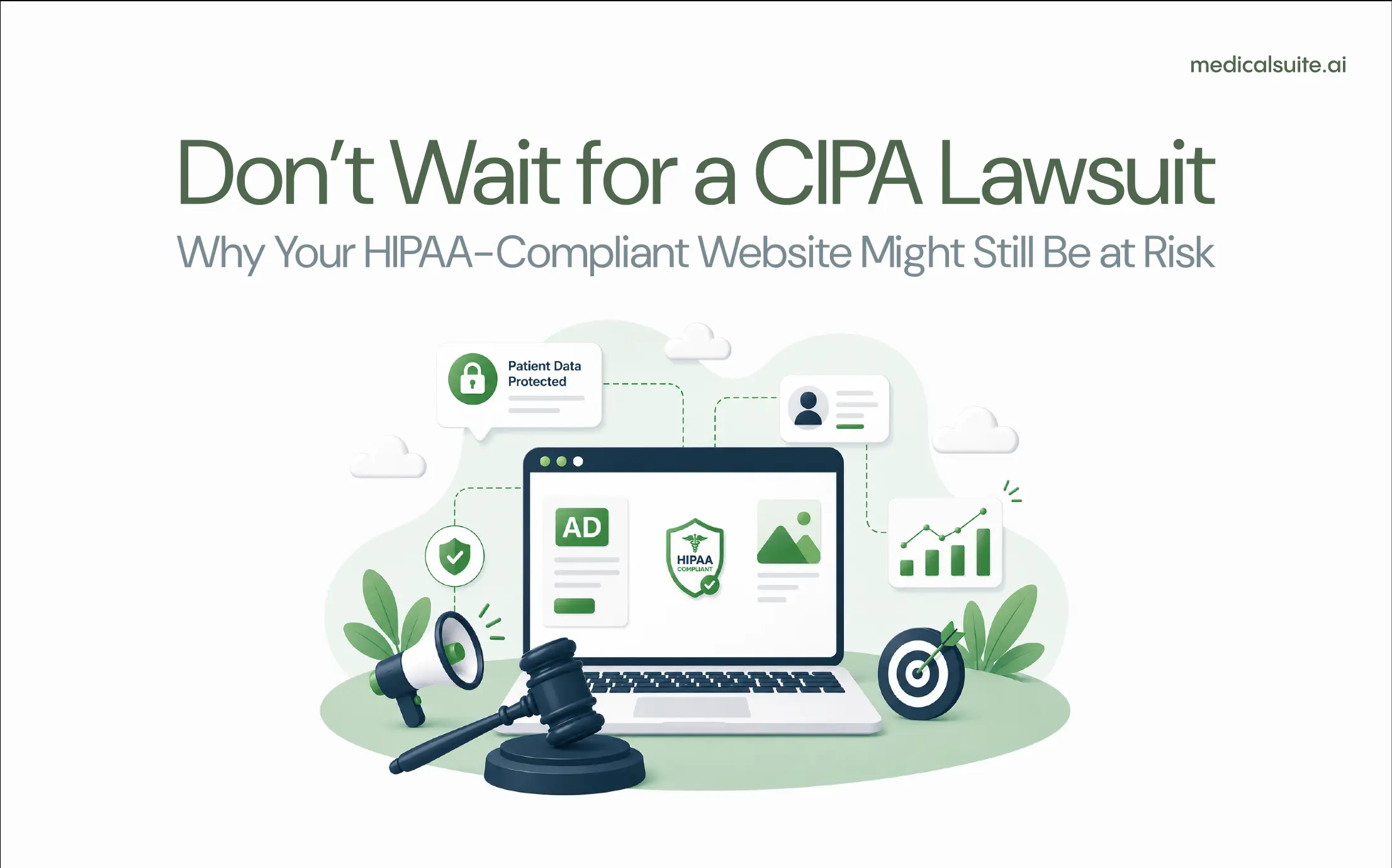
Across the country, especially in California, lawsuits filed under the California Invasion of Privacy Act (CIPA) are climbing fast. Most of these cases focus on how healthcare websites use tools like Google Analytics, Google Ads, Meta Pixel, Microsoft Clarity, and other marketing software.
One recent case against a healthcare provider alleged that the website sent visitors’ IP addresses, browser details, and other technical data to third-party advertising and analytics companies before visitors had a chance to give consent. The complaint pointed to what happened the moment the page loaded, before anyone even touched the cookie banner.
We don’t know yet how that case will turn out. But it teaches every healthcare organization the same thing:
Being HIPAA compliant isn’t the finish line. Compliance can’t be treated as something you deal with later.
Understanding the California Invasion of Privacy Act (CIPA)
CIPA is an old privacy law that’s become the center of many lawsuits involving websites and online tracking. Most of these complaints say the same thing: websites are sending data to third parties before visitors have actually consented.
The problem isn’t that a website uses Google Analytics or Meta Pixel. Plenty of sites do, and that’s fine.
The real problem is how those tools are set up.
If a marketing or analytics script starts sending visitor data before consent happens, that organization could be looking at legal trouble, regardless of how HIPAA-compliant its internal systems are.
For healthcare providers, where trust and privacy matter more than almost anywhere else, this needs real attention.
Why Healthcare Websites Face Higher Expectations

Healthcare is already one of the most regulated industries out there. Patients expect their information to stay private from the moment they land on your website, not just after they book an appointment.
Most healthcare websites today run tools like:
- Google Analytics 4
- Google Ads Conversion Tracking
- Google Tag Manager
- Meta Pixel
- Microsoft Clarity
- Live Chat Systems
- Appointment Scheduling Platforms
- Call Tracking
- CRM Integrations
- Marketing Automation Platforms
These tools genuinely help you measure your marketing and bring in more patients. But if they’re set up without real consent controls, they can create compliance problems that a HIPAA-compliant medical website alone won’t catch.
A Cookie Banner Isn’t the Same Thing as Being Compliant
This is where a lot of marketing agencies drop the ball. Just having a cookie banner on your site doesn’t mean tracking is actually blocked.
On many websites, marketing scripts start running the second the page loads, while the cookie banner is still sitting there waiting for someone to click yes or no.
If tracking is already happening before that click, the banner isn’t doing what it’s supposed to do, even on a site that’s technically a HIPAA-compliant medical website.
Real privacy protection means those marketing tools stay switched off until the visitor actually gives the go-ahead.
How MedicalSuite.ai Approached Healthcare Website Compliance
At MedicalSuite.ai, we saw these privacy risks coming long before they turned into a wave of lawsuits.
When we built websites for our clients, including GI Partners of Illinois, we didn’t rely on default marketing settings. We built a privacy-first consent system from the ground up, on top of a HIPAA-compliant foundation.
Our setup was built specifically to avoid the kind of tracking behavior showing up in today’s CIPA lawsuits. Instead of letting marketing tools run the moment a page loads, our websites work like this:
- Marketing cookies stay blocked until the visitor gives consent.
- Google Ads conversion tracking only turns on after consent is given.
- Google Analytics follows whatever the visitor chooses.
- Google Tag Manager only fires marketing tags once consent conditions are met.
- The cookie consent tool actually controls whether scripts run, not just displays a message.
- Marketing forms only ask for the information that’s truly needed.
- Patient lead funnels are built with privacy in mind from the start.
Because of this setup, our websites are built to cut down the risk of third-party tools tracking visitors before consent happens, going well beyond a standard HIPAA-compliant medical website.
We didn’t add privacy later. It was part of how we built the site from day one.
HIPAA Compliance Alone Isn’t Enough
One of the biggest misunderstandings in healthcare marketing is thinking that a HIPAA-compliant medical website automatically protects you from lawsuits like this.
HIPAA mainly covers how protected health information, or PHI, gets handled.
Website privacy involves a lot more than that, including:
- Cookie consent
- State privacy laws
- CIPA awareness
- Google’s healthcare advertising policies
- Meta’s healthcare advertising policies
- FTC advertising standards
- Secure data collection
- Consent management
- Accessibility
- Technical website security
Healthcare organizations need a full privacy strategy, not just a HIPAA-compliant checklist.
Our Privacy-First Healthcare Marketing Framework
Every website we build follows the same structured approach, starting with a HIPAA-compliant foundation and building outward:
Privacy-First Website Development: Built from scratch with secure architecture and real consent management.
HIPAA-Conscious Digital Marketing: Marketing campaigns designed to avoid exposing patient information unnecessarily.
Consent-Based Analytics: Analytics set up to respect what visitors choose and limit unnecessary data sharing.
Secure Patient Lead Funnels: Lead forms built to collect only what’s necessary and send it securely.
Google Ads Compliance: Healthcare ad campaigns are set up according to Google’s healthcare advertising rules and consent standards.
Meta Ads Compliance: Meta advertising is built with privacy in mind, reducing unnecessary data sharing.
SEO & Answer Engine Optimization (AEO): Helping you rank on Google Search, AI search tools, voice search, and answer engines without giving up privacy.
AI Search Optimization: Getting your website ready for the next wave of search while keeping strong privacy controls in place.
Questions Every Healthcare Practice Should Ask Their Marketing Agency
Before you trust anyone with your marketing, ask them:
- When do your Google Analytics scripts actually start running?
- Does Google Tag Manager respect consent signals?
- Are Meta Pixel events blocked until someone consents?
- How exactly is patient privacy being protected?
- How do you set up Google Consent Mode?
- What privacy checks do you run before launching a site?
- How do you lower the risk of a CIPA lawsuit, even on a HIPAA-compliant medical website?
- Do you actually specialize in healthcare compliance, or is this general marketing?
If they can’t answer these clearly, it’s worth asking whether they’re really the right fit to market a healthcare organization.
Why Healthcare Providers Choose MedicalSuite.ai
We don’t just build websites that look nice. We build growth systems for healthcare, and every one starts with a HIPAA-compliant medical website as the baseline, not the finish line.
Every project we take on combines:
- Privacy-first development
- HIPAA-conscious marketing
- SEO
- AEO
- AI Search Optimization
- Google Ads
- Meta Ads
- Secure lead generation
- Website security
- Performance optimization
- Compliance-focused implementation
Our goal isn’t just to get you more patient appointments. It’s to help your organization grow while keeping unnecessary compliance risk off your plate.
Because in healthcare, patient trust doesn’t start at the first appointment. It starts on your website.
Need a Healthcare Website Privacy Audit?
If your practice runs Google Analytics, Google Ads, Meta Pixel, Microsoft Clarity, or any other tracking tool, here’s a simple question worth asking: are these tools set up to respect consent before they turn on, even on a HIPAA-compliant medical website?
Schedule Your Appointment with MedicalSuite.ai Now to help you market with confidence while keeping patient trust intact.
Frequently Asked Questions
What are the three rules of HIPAA-compliant healthcare?
The three HIPAA-compliant rules are the Privacy Rule, Security Rule, and Breach Notification Rule.
What are the consequences of not being HIPAA-compliant?
Failing to remain HIPAA-compliant can result in fines, legal penalties, and reputational damage.
What are the minimum necessary rules under HIPAA-compliant practices?
HIPAA-compliant practices require limiting access to only the minimum protected health information needed for a task.
What is HIPAA-compliant compliance?
HIPAA-compliant compliance means following HIPAA regulations to protect the privacy and security of patient health information.