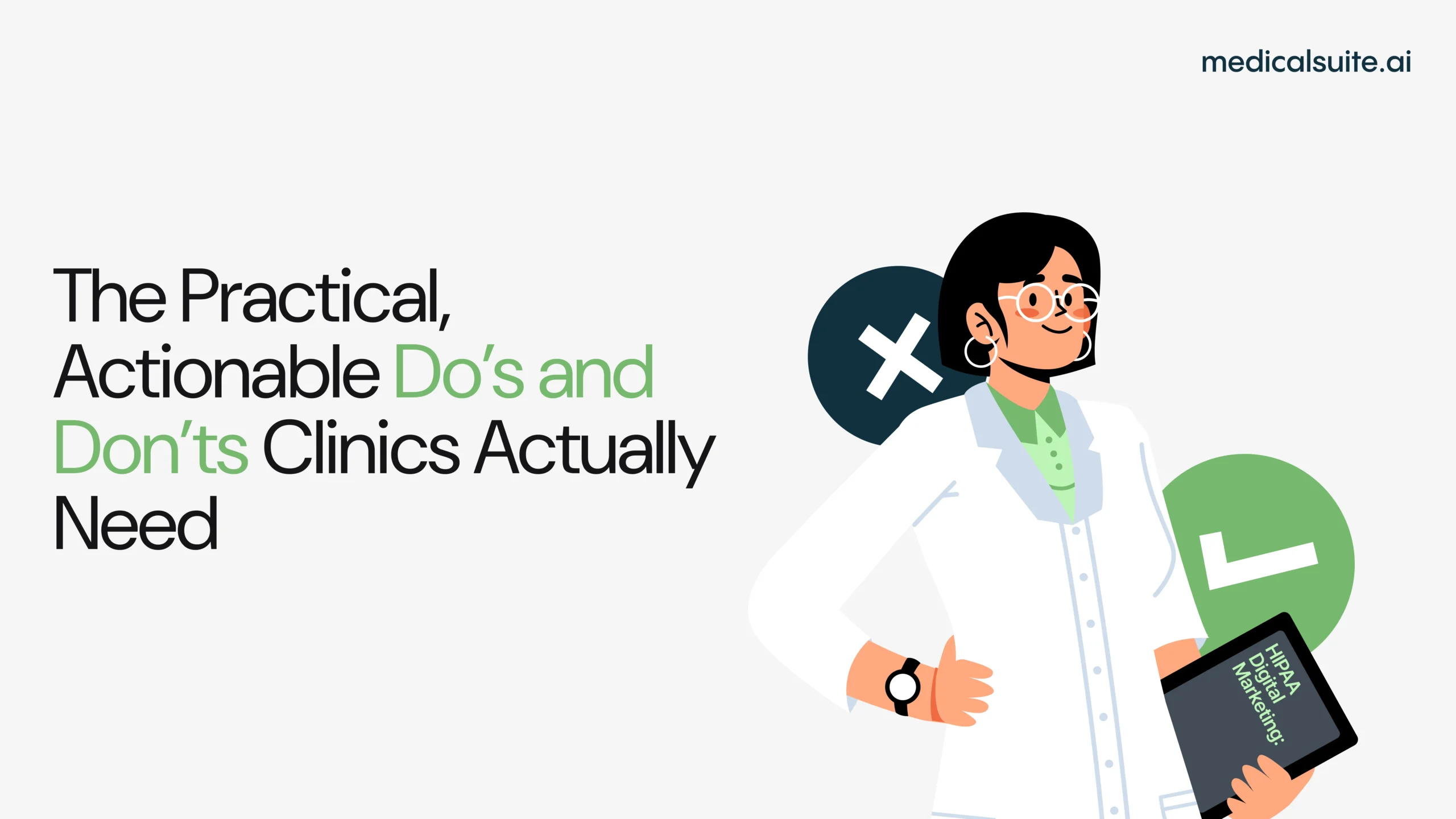
HIPAA-compliant digital marketing is one of those things every healthcare clinic knows they should care about… but no one really wants to deal with. You’re trying to grow, attract new patients, and keep your schedule full, not become a compliance expert. Still, HIPAA affects almost everything you do online, from your website forms and appointment requests to your email campaigns and ads. And if it’s handled wrong, it’s not just a “marketing mistake,” it’s a legal and trust problem that can cost you real money and credibility.
At MedicalSuite, we often see this tension: clinics want modern marketing, but they also want peace of mind. That’s why we focus on helping healthcare practices grow in a way that’s smart, ethical, and actually sustainable. You shouldn’t have to choose between getting more patients and protecting them, and you definitely shouldn’t have to guess whether your marketing setup is safe or not.
First: What HIPAA really means for your marketing
HIPAA exists to protect patient health information, including anything that can identify a patient and link them to medical services, conditions, or treatments.
That includes:
- Names tied to conditions
- Email addresses tied to appointments
- Form submissions with symptoms
- Chat messages asking for medical advice
- Reviews, testimonials, and before-and-after photos
Yes, HIPAA absolutely applies to your website, forms, email system, CRM, ads, and sometimes even your social media.
This doesn’t mean you can’t market. It just means you can’t be careless.
The Do’s
1. Do treat your website like part of your clinic, not just a brochure
Your website isn’t just a “marketing thing.” It’s often the first place patients share personal information.
Contact forms, appointment requests, symptom checkers, all of these collect protected data. That means your hosting, your form tools, your database, and your integrations all need to respect HIPAA standards.
One clinic we worked with had a beautifully designed site… that sent form submissions straight to a shared Gmail inbox. Convenient? Yes. Compliant? Not even close.
Fixing that one thing reduced their risk massively.
2. Do use secure, compliant tools for forms and communication
If you’re collecting any patient information online, you need:
- Encrypted data transmission (HTTPS)
- Secure storage
- Access control (not everyone on your team should see everything)
- A Business Associate Agreement (BAA) with your vendors
This is where HIPAA becomes very operational, very fast.
Email marketing is a good example. You can absolutely do email, but not with standard platforms in the same way ecommerce brands do. You need compliant email systems, and you need to be careful what content goes into them.
Yes, it’s a little more work. But it’s far less work than dealing with a breach.
3. Educate your staff (because humans are the weakest link)
You can have the best tech stack in the world, and it still only takes one well-meaning front desk employee replying to a patient from their personal phone to create a problem.
We’ve seen it happen.
Marketing doesn’t exist in a vacuum. If your team doesn’t understand HIPAA basics, your marketing efforts will always be fragile.
Short trainings go a long way.
4. Do use patient stories the right way
Social proof matters. People trust people.
You can use testimonials and stories, but only with explicit, documented consent. And even then, be thoughtful about what’s shared.
“Thanks to Dr. Smith, my back pain is finally gone!” is very different from “Thanks to Dr. Smith for helping me manage my spinal condition after my accident on I-94.”
Specificity increases risk. Generality protects privacy.
You don’t need drama to build trust.
5. Do think long-term, not just “get more leads.”
Some clinics get so focused on volume that they forget about stability.
If your growth strategy depends on shaky tools or questionable practices, it’s not growth, it’s borrowed time.
HIPAA-aligned marketing tends to be a bit slower, a bit more deliberate, and a lot more sustainable.
The Don’ts
1. Don’t collect more data than you actually need
This is a huge one.
We often see forms asking for:
- Full medical histories
- Insurance numbers
- Detailed symptoms
…on the first contact.
Why? Usually “just in case.”
But every extra field increases risk, liability, and friction. Collect the minimum needed to start the conversation. You can gather the rest later in secure clinical systems.
Marketing is not intake.
2. Don’t use generic marketing tools without checking compliance
Just because a platform is popular doesn’t mean it’s safe for healthcare.
We’ve seen clinics use:
- Free chat widgets
- Public calendar tools
- CRM systems built for real estate or gyms
None of those are designed with HIPAA in mind.
This doesn’t mean they’re “bad.” It means they’re the wrong tool for the job.
3. Don’t reply to medical questions publicly
It’s tempting. Someone comments on your post: “Is this treatment safe for diabetics?” And you want to be helpful.
But public replies can easily turn into disclosures or medical advice, both of which can cross lines fast.
A safer move: acknowledge, stay general, and move the conversation to a secure, private channel.
4. Don’t assume vendors “handle compliance for you.”
We hear this a lot: “Our website company said it’s compliant.”
That’s not enough.
Ask questions:
- Do you sign a BAA?
- How is data stored?
- Who has access?
- How long is data retained?
If they can’t answer clearly, that’s your answer.
5. Don’t let fear stop you from marketing at all
Some clinics swing too far the other way and do… nothing.
No content, no ad, no outreach. Just a static site and hope.
That’s not safety, that’s stagnation.
You can grow responsibly. You just have to be intentional.
A quick reality check
HIPAA isn’t your enemy. It’s a framework.
It forces you to be more thoughtful, more respectful, and more professional with how you handle patient trust. And honestly? That usually makes your marketing better, not worse.
Patients can feel when you take their privacy seriously. It builds credibility before you ever meet them.
How MedicalSuite helps
At MedicalSuite, we build growth systems specifically for healthcare clinics with compliance baked in, not bolted on.
Our services include:
- Digital Marketing
- Email Marketing
- PPC Ads
- HIPAA-compliant systems
- ADA-compliant custom websites
- Data automation
We’ve helped clinics like Greenleaf Medical Associates, GI Partners of Illinois, and many others improve visibility, increase patient volume, and grow without putting themselves at risk.
Ready to grow without guessing?
If your marketing feels messy, risky, or just plain confusing, you don’t need more hacks; you need a system that actually fits healthcare.
Book your appointment and let’s build something great for your clinic.