
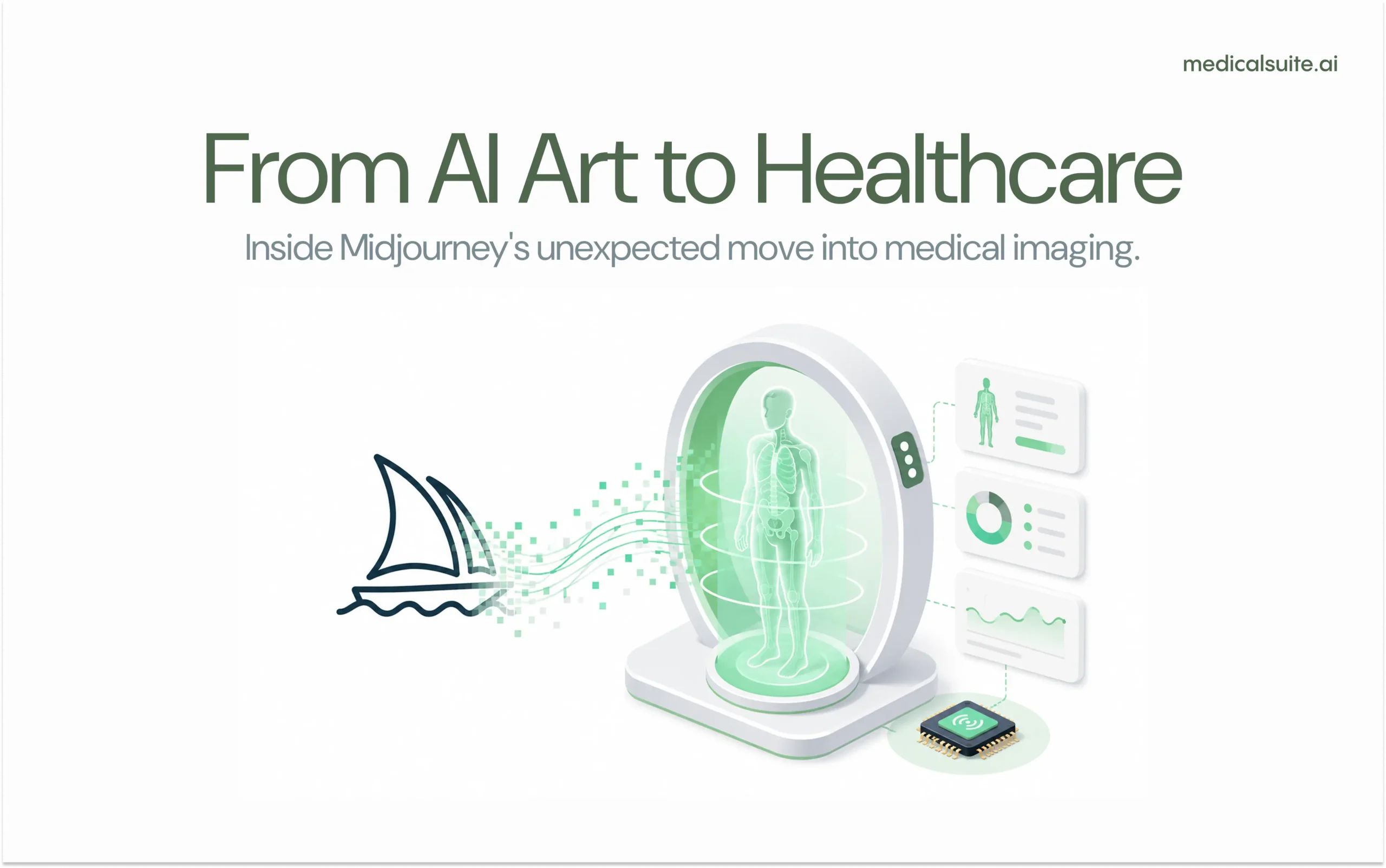
You know Midjourney as the AI tool that turns a few words into stunning artwork. So when the company announced it was building a full-body medical scanner, most of the healthcare world did a double-take.
This isn’t a rebrand or a side project. Midjourney has launched a new division called Midjourney Medical, and its first product is a full-body ultrasound scanner wrapped inside a luxury spa experience. For clinic owners and healthcare administrators, this story matters more than it might first appear.
What Midjourney Is Actually Building
The Midjourney Scanner is a full-body ultrasound system designed to produce detailed 3D images of your internal anatomy in about 60 seconds. Here’s the basic idea:
- You stand on a platform that lowers into warm water at roughly five centimeters per second.
- As you descend, hundreds of thousands of tiny ultrasonic sensors surround your body, sending sound waves through you and reading the echoes, similar to how dolphins use echolocation.
- Thousands of computers then reconstruct that data into a 3D map of your muscles, fat, bones, and organs.
Midjourney CEO David Holz has said the results are, in his words, superior to MRI in some ways, citing speed and the absence of radiation. He’s also been upfront that this is a long-term goal rather than where things currently stand. Right now, the Midjourney Scanner is a prototype, not a clinical replacement for MRI.
The Hardware Behind Midjourney’s Scanner
Here’s something worth knowing before you take any of the marketing at face value: Midjourney didn’t build the core hardware. That came from Butterfly Network, a Nasdaq-listed ultrasound company.
Each scanner uses 40 of Butterfly’s “ultrasound-on-chip” modules, part of a licensing deal reportedly worth up to $74 million over five years. When the partnership was announced, Butterfly’s stock jumped 56% in a single day.
Even Holz has acknowledged that AI isn’t doing much of the heavy lifting yet. He’s stated plainly that the current version relies on hardware and software, not AI, though the company does use AI to help segment and label what the scans capture. The imaging itself comes down to ultrasound and signal processing, technology Midjourney didn’t invent but is now packaging in a new way.
Why a Spa, Not a Clinic

This is the part that makes Midjourney’s move genuinely clever, and worth paying attention to.
Instead of positioning the scanner as a medical device, it is building it into a wellness experience. The first Midjourney Spa is planned for San Francisco’s Union Square by the end of 2027, complete with hot tubs, saunas, cold plunges, and a gym, with scanning rooms tucked in alongside.
The scan is framed as a “side effect” of a relaxing day out. You go to unwind, and you leave with a personal library of health data.
There’s a regulatory angle here too. By calling it a wellness tool instead of a diagnostic device, Midjourney sidesteps the rigorous FDA approval process required for medical imaging equipment. That’s a smart business move, but it also creates a real problem for clinics: patients may not understand the difference between a wellness scan and an actual diagnosis.
The Regulatory Gaps Nobody Should Ignore
Midjourney is throwing around bold numbers, like 30% fewer deaths and 50% lower healthcare costs, but those claims deserve scrutiny.
- No FDA clearance yet. The scanner currently produces body composition maps under the FDA’s general-wellness policy. Anything diagnostic, the piece that would make it a true MRI competitor, still requires approval Midjourney hasn’t secured. The company says it plans to submit test results to the FDA over time.
- Radiologists are openly skeptical. Experts who spoke to The Verge described Midjourney’s claims as wildly unsubstantiated and the sample images as low resolution.
- Ultrasound has physical limits. Sound waves don’t travel well through bone or air, meaning the scanner can’t effectively image the brain, lungs, or bowels. Fat also weakens ultrasound signals, raising real questions about accuracy for larger bodies.
What’s Still Genuinely Unknown
There’s a long list of open questions surrounding the Midjourney Scanner:
- How sharp will the final images actually be?
- How will the scanner perform across different body types?
- Will the water bath stay hygienic between uses?
- What will a scan cost, and who will realistically be able to afford it?
- What clinical value does a body composition map offer a healthy person in the first place?
It has a prototype and an ambitious vision. But the gap between prototype and validated medical product is exactly where many healthcare ventures stumble.
Why This Should Be on Your Radar
Two trends are converging here, and both are relevant whether or not Midjourney’s scanner lives up to its promises.
First, patients are generating more health data outside the clinic than ever before, often without any FDA oversight. This is the same challenge we’ve seen with wearables, just amplified.
Second, “wellness” branding is increasingly being used to bypass regulatory scrutiny. Patients won’t necessarily understand that distinction. They’ll bring these scans into your office expecting clinical interpretation, and you’ll need to explain why a wellness scan isn’t a diagnostic one.
Midjourney has also said users will be able to share scan results with doctors, AI-based services, and other medical systems. That raises real questions about data handling, consent, and HIPAA compliance that clinics should start thinking through now.
What Smart Clinics Are Doing Right Now
- Educating patients on the difference between wellness scans and diagnostic imaging
- Updating consent forms to account for data coming from non-clinical sources
- Tracking Midjourney’s regulatory progress, since FDA approval would change the clinical landscape
- Asking hard questions before integrating any new external data source into existing workflows
- Staying cautious about whole-body screening in healthy patients, since ambiguous findings can trigger unnecessary anxiety and follow-up procedures
Don’t Let Innovation Outpace Your Clinic.
New wellness technologies are changing patient expectations faster than ever.
Stay prepared with MedicalSuite.ai helping clinics navigate compliance, integrate emerging health data, and communicate with confidence.
Book your free consultation today and future-proof your practice!
Frequently Asked Questions
Is the Midjourney Scanner FDA-approved?
No. It currently operates under the FDA’s general-wellness policy, not as a diagnostic medical device. Midjourney has said it plans to pursue FDA approvals over time.
How does the Midjourney Scanner work?
It uses full-body ultrasound technology from Butterfly Network. As you’re lowered into warm water, ultrasonic sensors capture data that’s reconstructed into a 3D image of your muscles, fat, bones, and organs.
Can the Midjourney Scanner replace an MRI?
Not currently. Radiologists have raised concerns about image resolution and ultrasound’s physical limitations, particularly with bone, air-filled organs, and body fat.
Where is the first Midjourney Spa opening?
San Francisco’s Union Square, planned for late 2027.