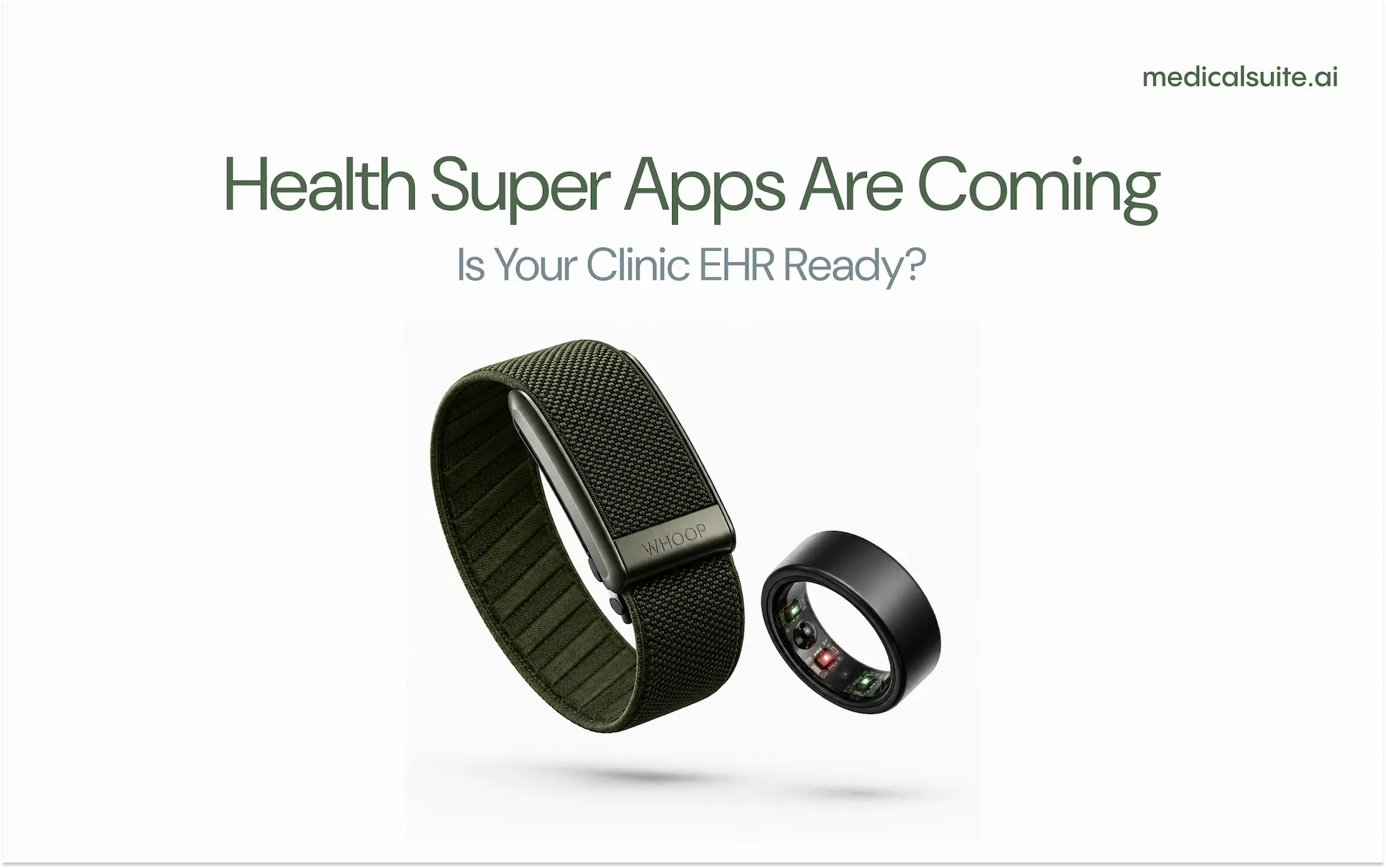
A patient walks in wearing a smart ring that has tracked their heart rate, sleep, and activity for six months. They open an app, one of the new health super apps, and that data is suddenly sitting inside their medical record.
This isn’t a future scenario. It’s already happening.
WHOOP now lets members connect their medical records directly within its app, functioning as an early health super app for its 2.5 million members. Garmin data is already flowing into healthcare systems through the FHIR standard, with one deployment pulling over 1.5 million datasets from more than 4,500 users.
A health super app is a single platform where wearable data, medical records, insurance claims, and clinical history all live together. That idea is no longer a fitness trend. It’s becoming clinical infrastructure. But the technology is moving faster than the safeguards around it, and clinics that aren’t prepared could be the ones holding the liability when something goes wrong.
What’s Actually Happening Right Now
Consumer wearables are shifting from fitness gadgets into clinical tools, whether health systems are ready or not.
WHOOP, valued at $10.1 billion, now lets clinicians view a member’s biometric data alongside bloodwork and medical history in one place. Oura has positioned itself even more aggressively in this direction, hiring Apple’s former head of health as its chief medical officer.
The federal government is pushing toward the same vision. In 2025, the administration announced plans to partner with Apple, Google, Amazon, CVS, and UnitedHealth to build a “patient-centric digital health ecosystem” where patients could opt in to connect medical records, insurance claims, and wearable data into one system.
The technical groundwork is being laid too. One study mapped Garmin heart rate, step count, sleep, and activity data to FHIR resources for transfer into healthcare information systems. Another validated real-world collection of over 1.5 million datasets from more than 4,500 users using the FHIR format.
The problem: the infrastructure for seamless integration isn’t fully built, and the legal framework around it is a patchwork.
The Three Big Problems With Health Super Apps
1. Data Quality Is Questionable
Wearables are good at tracking trends. Clinical-grade accuracy is a different story.
At rest, heart rate tracking is generally reliable, with mean absolute errors around 2 beats per minute. Accuracy drops during activity when contact pressure, sweat, and arm movement all interfere with readings.
Body composition tracking shows similar gaps. A study comparing a Samsung Galaxy Watch5 to a gold-standard DXA scan found a strong correlation for body fat percentage (r=0.93), but a 14.3% mean absolute percentage error. Core temperature tracking fared worse, with one study finding bias exceeding 0.8°C and correlations as low as r≤0.53.
Bottom line: a device that counts steps is one thing. A health super app feeding that data into a clinical decision is another. Clinicians frequently cite poor data quality and unclear data provenance as the biggest barriers to using patient-generated health data (PGHD).
2. Integration Is a Technical Nightmare
Most wearables run on proprietary ecosystems with no standardized data format, which makes reliable EHR integration difficult by design.
The FHIR standard is emerging as the leading fix. Researchers have also proposed an ontology called WearPGHDProv, built specifically to track the source and quality of wearable-generated data so it can be trusted inside a clinical record.
But interoperability needs more than a technical patch. It requires coordination between health systems, technology vendors, regulators, and patients around data validation, privacy, and usability. Even when the data flows in, the sheer volume can overwhelm clinical workflows.
3. The Privacy Gap Is Massive
This is the part that should concern every clinic owner: most consumer wearables, and the apps built on top of them, aren’t covered by HIPAA. Once wearable data leaves your EHR and enters a consumer app, HIPAA’s protections largely disappear.
Senator Bill Cassidy (R-LA) introduced the Health Information Privacy Reform Act (HIPRA) on November 4, 2025, aimed at closing that gap. HIPRA would:
- Create a new “Applicable Health Information” category for data outside provider systems
- Require HIPAA-like privacy, security, and breach standards for consumer health data
- Give patients the right to access, correct, delete, and transfer their data
- Require disclosure when HIPAA protections don’t apply
- Require consent before selling health information
HIPRA is a federal signal, but states are already moving faster. Washington’s My Health My Data Act and New York’s Health Information Privacy Act have shifted from a “use it unless restricted” model to “prohibited unless authorized.”
What Health Super Apps Mean for Your Clinic
Patients will expect you to use their data.
They’re wearing these devices daily. Most have no idea their data isn’t legally protected the way their medical records are, and your clinic will likely be the one explaining that to them.
Liability risk is real.
If you recommend wearables or rely on their data for clinical decisions, weak data quality and unclear provenance create exposure. Patients who “jailbreak” devices to bypass manufacturer restrictions add another layer of risk, since modified devices can malfunction or trigger incorrect clinical interventions.
Regulation is coming fast.
Even if HIPRA doesn’t pass as written, law firms are already advising clients to treat all data flowing through these apps as if HIPAA-level protections already applied.
Your EHR may not be ready.
True interoperability with any health super app requires standardized data formats and communication protocols that are still years from widespread adoption.
How to Prepare Your Clinic for Health Super Apps (5 Steps)
- Ask questions before recommending wearables or a health super app. How is the data used, stored, and protected? What happens in a breach?
- Educate your patients. Most assume data inside a health super app is protected like a medical record. It isn’t, and your clinic can be the one that tells them the truth.
- Update your consent forms. Make sure patients understand exactly what they’re agreeing to if you use wearable data clinically.
- Watch the legal landscape. Build a single inventory of health-related data, covering PHI, consumer health data, wellness data, wearable streams, and AI training data, regardless of where it originated.
- Run a vendor audit. Review the privacy policies and data practices of any wearable you recommend before you recommend it.
The Smartest Move You Can Make Today
This is a lot to digest: new technology, new health super apps, new compliance questions layered on top of running a practice.
That’s where MedicalSuite.ai comes in. We’re a growth consultancy built specifically for healthcare practices navigating technology and compliance together. Book a free consultation, and we’ll review your current data practices, consent forms, and marketing setup, then show you exactly where your risk sits and how to fix it.
[Book your free consultation today.]
What is a health super apps?
Health super apps are a single platform that combines wearable biometric data, medical records, insurance claims, and clinical history in one place, giving patients and clinicians a unified view of health information.
Is data inside health super apps protected by HIPAA?
Usually not. Most consumer wearables and the health super apps built on top of them fall outside HIPAA’s scope. Once health data leaves a HIPAA-covered EHR and enters a consumer app, it typically loses those legal protections.
What is HIPRA and how does it affect health super apps?
HIPRA (the Health Information Privacy Reform Act) is a federal bill introduced in November 2025 that would require HIPAA-like protections for consumer health data, including data flowing through health super apps, and give patients the right to access, correct, delete, and transfer that data.
Can a clinic be liable for recommending a health super apps?
Yes, potentially. Poor data quality, unclear data provenance, and patient-modified (“jailbroken”) devices feeding into a health super app can all expose clinics to liability if that data informs a clinical decision that leads to harm.
Should my clinic recommend a health super apps to patients?
Not without due diligence. Before recommending any health super apps, clinics should review its privacy policy, confirm what happens to data if the company is acquired or shuts down, and check whether the app discloses data-sharing practices with third parties like insurers or advertisers. A quick vendor audit now can prevent liability exposure later.